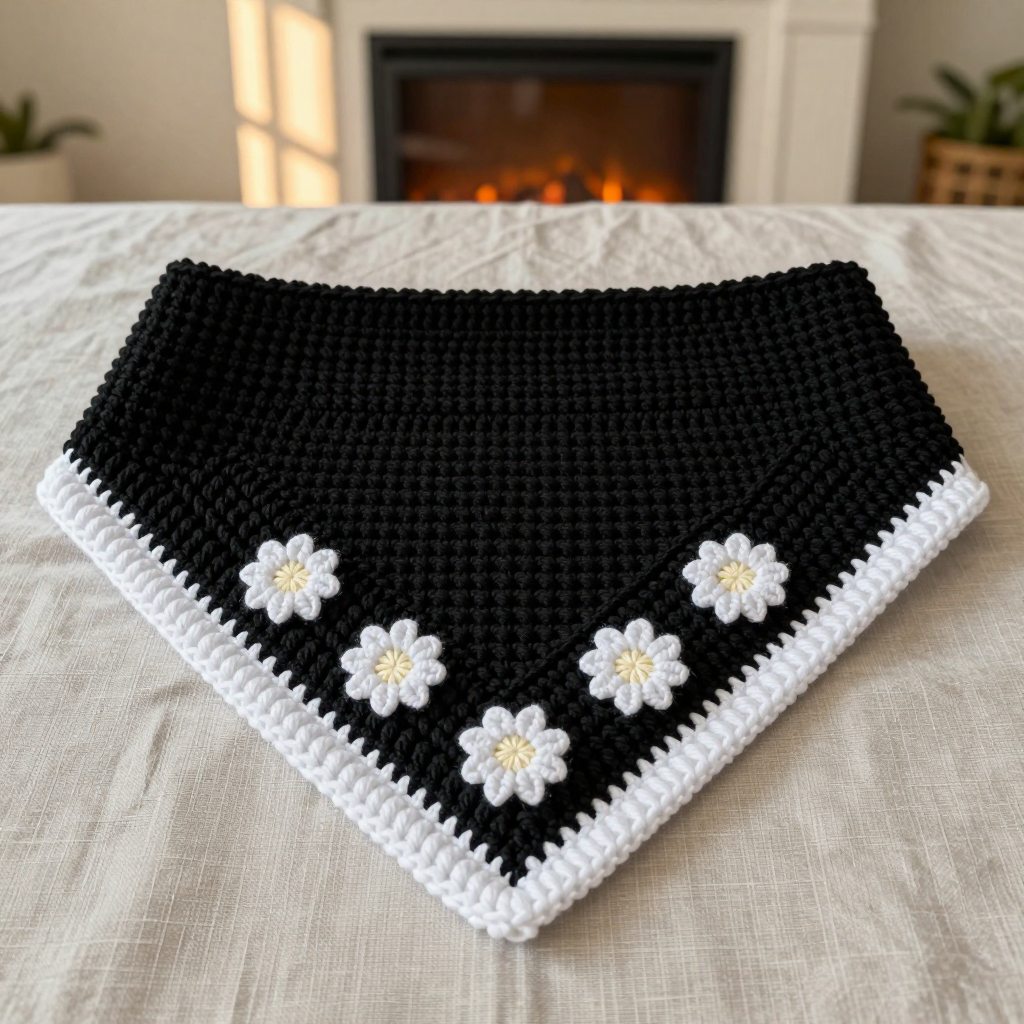
Champs-Élysées Capelet Free Crochet Pattern

Champs-Élysées Capelet Free Crochet Pattern
Introduction
This capelet is for anyone who wants a little Parisian polish without a complicated pattern. It is worked as a simple tube with a front slit, so the construction stays beginner-friendly while the result looks effortlessly elegant. The charcoal tweed body has a dense, cozy texture, and the tall cream cowl neck frames the face like a soft scarf. Slip it over a turtleneck or a simple dress and it feels warm, drapey, and quietly chic.
Materials Needed
- Yarn: Worsted weight (4) tweed yarn, 200–220 yards per 100 g skein.
- Color A (main): approx. 600 yards charcoal tweed (3 skeins). Sample uses Lion Brand Wool-Ease Tonal in Charcoal.
- Color B (contrast): approx. 200 yards cream tweed (1 skein). Sample uses Lion Brand Wool-Ease Tonal in Fisherman.
- Hook: 8 mm (US L-11) crochet hook.
- Notions: stitch marker, tapestry needle, scissors, tape measure.
- Finished size: One size fits most (S–XXL). Bottom circumference approx. 56 inches (142 cm); shoulder-to-hem length approx. 20 inches (51 cm); cowl height approx. 8 inches (20 cm); slit length approx. 10 inches (25 cm).
Abbreviations
- ch — chain: make a loop of yarn and pull it through the loop on your hook.
- sl st — slip stitch: insert hook, yarn over, pull through both the stitch and the loop on your hook.
- hdc — half double crochet: yarn over, insert hook in stitch, yarn over, pull up a loop, yarn over, pull through all 3 loops.
- sc — single crochet: insert hook in stitch, yarn over, pull up a loop, yarn over, pull through both loops.
- st(s) — stitch(es).
- sp — space.
- R / Rnd — row / round.
Gauge
12 stitches and 8 rows = 4 inches (10 cm) in half double crochet after blocking. Work a small swatch in hdc, block it lightly, and measure a 4-inch section; if you have more stitches, go up a hook size, and if you have fewer, go down.
Tips Before You Start
- Count your 168 chains carefully before joining — the circumference depends on it, and an accidental twist at the join cannot be fixed later.
- Use a stitch marker at the start of each round so you always know where to join.
- The front slit is created in Row 5 by working only half the round; read that row twice before you begin it.
- Tweed yarn hides small tension differences, so relax and keep your hdc loops even rather than tight.
Step-by-Step Instructions
Capelet Body (Color A)
Set-up: Ch 168, join with sl st to first ch to form a ring, being careful not to twist.
Rnd 1: Ch 1, hdc in each ch around, join with sl st to first hdc (168 hdc).
Rnds 2–4: Ch 1, hdc in each st around, join (168 hdc).
Rnd 5: Ch 1, hdc in first 84 sts, ch 2, skip next 84 sts (front slit opening), join with sl st to first hdc (84 hdc, 2 ch-2 sps).
Rnds 6–24: Ch 1, hdc in each st and in each ch-2 sp around, join (168 hdc). Fasten off.
Cowl (Color B)
Set-up: With B, join yarn to any st at the top edge of the capelet.
Rnd 1: Ch 1, hdc in each st around, join (168 hdc).
Rnds 2–12: Ch 1, hdc in each st around, join (168 hdc). Fasten off.
Edging (Color B)
Bottom edge, Rnd 1: Join B to bottom edge of capelet, ch 1, sc in each st around, join (168 sc). Fasten off.
Slit opening: Repeat the edging round around the slit opening, working sc evenly into the stitches and chain spaces along the opening, join. Fasten off.
Cowl top edge: Repeat the edging round around the cowl top edge, working sc in each st around, join (168 sc). Fasten off.
Assembly and Finishing
There is no seaming — the capelet is worked in one tube and the cowl is joined directly to the top edge. Weave in all ends on the wrong side, threading each tail through a few stitches before trimming. Block lightly to measurements: mist with water, pat into shape, and lay flat to dry, keeping the bottom edge and cowl from stretching out of shape.
Pro Tips and Variations
- For a longer, more dramatic ruana, add extra hdc rounds to the body before the edging.
- Swap the cream cowl for a deep burgundy or camel tweed for a different seasonal look.
- Work the edging in the main color instead of the contrast for a more subtle, tonal finish.