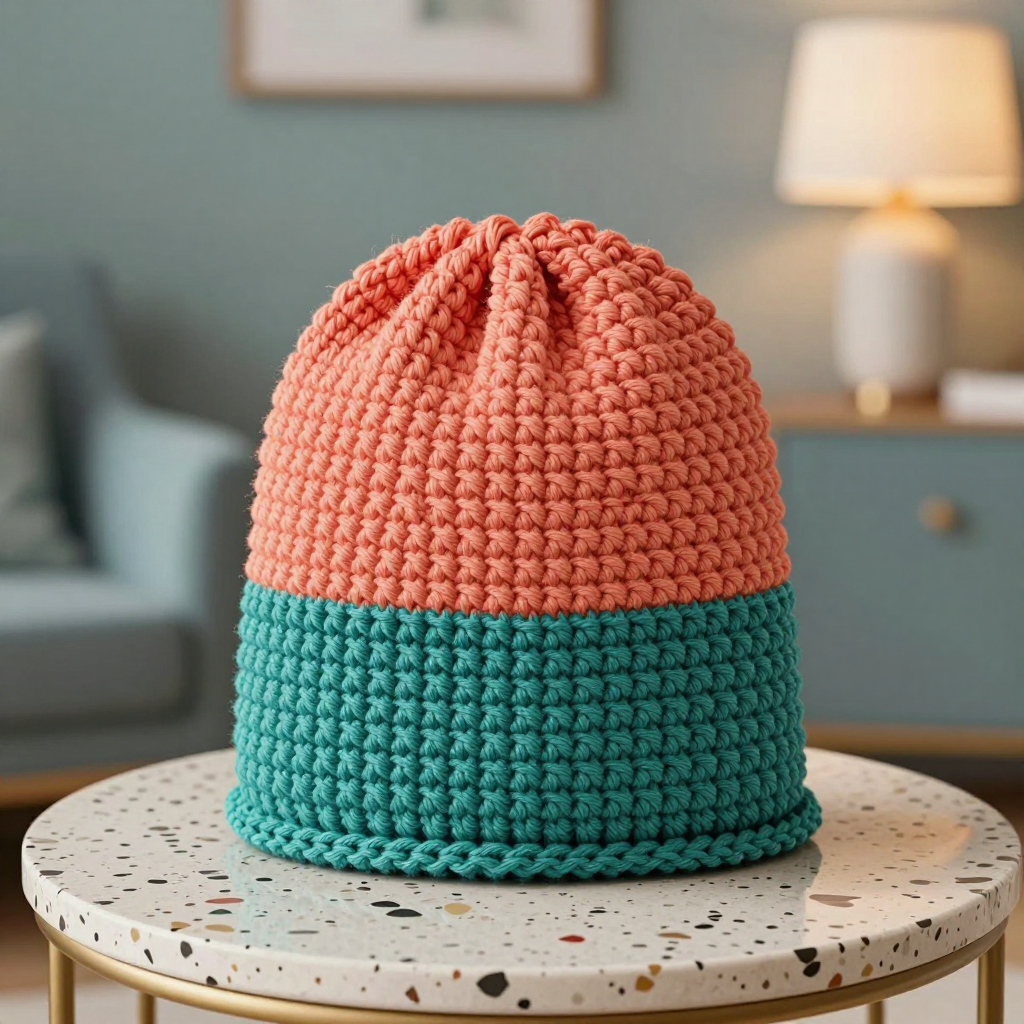
Emerald Fan Tile Runner: Free Crochet Pattern

Introduction
The Emerald Fan Tile Runner is a beginner-friendly Tunisian crochet project that turns twelve simple fan-shaped motifs into a striking 30 by 60 inch table runner. Each tile is worked in smooth Tunisian knit stitch, so the fabric looks and feels almost like a hand-knit piece — soft, drapey, and a little bit glamorous. Six tiles in rich emerald and six in soft blush are joined in a checkerboard, and the tapered fans line up into a repeating art deco pattern that gives off a playful space-age Halloween vibe. If you can chain and pull up loops, you can make this runner, and the finished piece is sturdy enough for everyday use but pretty enough to leave out all year.
Materials Needed
- Yarn: Worsted weight (category 4) cotton, approximately 1000 yards total — 500 yards emerald (A) and 500 yards blush (B). The sample uses Paintbox Yarns Cotton Aran (100% cotton, 50g/85m per ball): 6 balls A and 6 balls B.
- Hook: 6.0 mm (US J-10) Tunisian crochet hook with cable.
- Notions: Tapestry needle, stitch markers, scissors, spray bottle for blocking, and rust-proof pins.
- Finished size: Approximately 30 inches (76 cm) wide by 60 inches (152 cm) long.
Abbreviations
- ch — chain: yarn over and pull through the loop on your hook.
- st(s) — stitch(es).
- RS — right side: the front face of the work.
- Tks — Tunisian knit stitch: insert the hook under the front vertical bar of the next stitch, yarn over, and pull up a loop.
- tks2tog — Tunisian knit stitch two together: work a decrease by pulling up one loop through each of the next two stitches, then close them together on the return pass.
- yo — yarn over.
- sc — single crochet: insert hook, yarn over, pull up a loop, yarn over, pull through both loops.
- sl st — slip stitch: insert hook, yarn over, pull through all loops on the hook.
Gauge
14 stitches and 14 rows = 4 inches (10 cm) in Tunisian knit stitch. Work a small swatch and measure it flat without stretching; if you have more stitches than this, go up a hook size, and if you have fewer, go down.
Tips Before You Start
- Keep your loops loose on the forward pass — tight loops make the return pass slow and the fabric stiff.
- Count loops on the hook at the end of every forward pass; the stitch count in each row tells you exactly how many you should have.
- Make all twelve motifs before joining so you can lay them out and check the checkerboard before any seaming.
- Cotton has little stretch, so weave in ends securely and block the finished runner to even out the fan points.
Step-by-Step Instructions
Fan Motif (make 12 — 6 in A, 6 in B)
Row 1 (RS): Ch 22, pick up 21 loops in the back bumps. Return pass: yo, pull through 1 loop, [yo, pull through 2 loops] across (21 sts).
Row 2: Tks across, return pass (21 sts).
Rows 3-4: Repeat Row 2 (21 sts).
Row 5: Tks 10, tks2tog, tks 9 (20 sts). Return pass.
Row 6: Tks 9, tks2tog, tks 9 (19 sts). Return pass.
Row 7: Tks 8, tks2tog, tks 9 (18 sts). Return pass.
Row 8: Tks 8, tks2tog, tks 8 (17 sts). Return pass.
Row 9: Tks 7, tks2tog, tks 8 (16 sts). Return pass.
Row 10: Tks 7, tks2tog, tks 7 (15 sts). Return pass.
Row 11: Tks 6, tks2tog, tks 7 (14 sts). Return pass.
Row 12: Tks 6, tks2tog, tks 6 (13 sts). Return pass.
Row 13: Tks 5, tks2tog, tks 6 (12 sts). Return pass.
Row 14: Tks 5, tks2tog, tks 5 (11 sts). Return pass.
Row 15: Tks 4, tks2tog, tks 5 (10 sts). Return pass.
Row 16: Tks 4, tks2tog, tks 4 (9 sts). Return pass.
Row 17: Tks 3, tks2tog, tks 4 (8 sts). Return pass.
Row 18: Tks 3, tks2tog, tks 3 (7 sts). Return pass.
Row 19: Tks 2, tks2tog, tks 3 (6 sts). Return pass.
Row 20: Tks 2, tks2tog, tks 2 (5 sts). Return pass.
Row 21: Tks 1, tks2tog, tks 2 (4 sts). Return pass.
Row 22: Tks 1, tks2tog, tks 1 (3 sts). Return pass.
Row 23: Tks2tog, tks 1 (2 sts). Return pass.
Row 24: Tks2tog (1 st). Return pass. Fasten off.
Assembly
Arrange the 12 motifs in 3 rows of 4, alternating colors in a checkerboard: Row 1 A-B-A-B, Row 2 B-A-B-A, Row 3 A-B-A-B. With RS facing, whipstitch the motifs together through the back loops of the edge stitches, matching the fan shapes as you go. Sew the long edges and the short edges to form the runner.
Edging
Round 1: With RS facing, join A with sc in any corner, sc evenly around the entire perimeter, working 3 sc in each corner. Join with sl st to first sc. Fasten off. Weave in ends.
Assembly and Finishing
Seam all twelve motifs as described above, working the whipstitch snugly but not so tight that the fans pucker. Weave in every end on the wrong side, threading each tail through several stitches before trimming. Block the runner by misting it lightly, pinning it to the finished measurements of 30 by 60 inches, and allowing it to dry completely before removing the pins.
Pro Tips and Variations
- Swap the blush for charcoal or pumpkin orange for a bolder, more overtly Halloween palette.
- Make a shorter version by using 8 motifs in 2 rows of 4 for a 30 by 40 inch table runner.
- Work the edging in B instead of A for a contrasting outline that frames the checkerboard.