Tropical Leaf Crochet Edging Free Pattern
Introduction
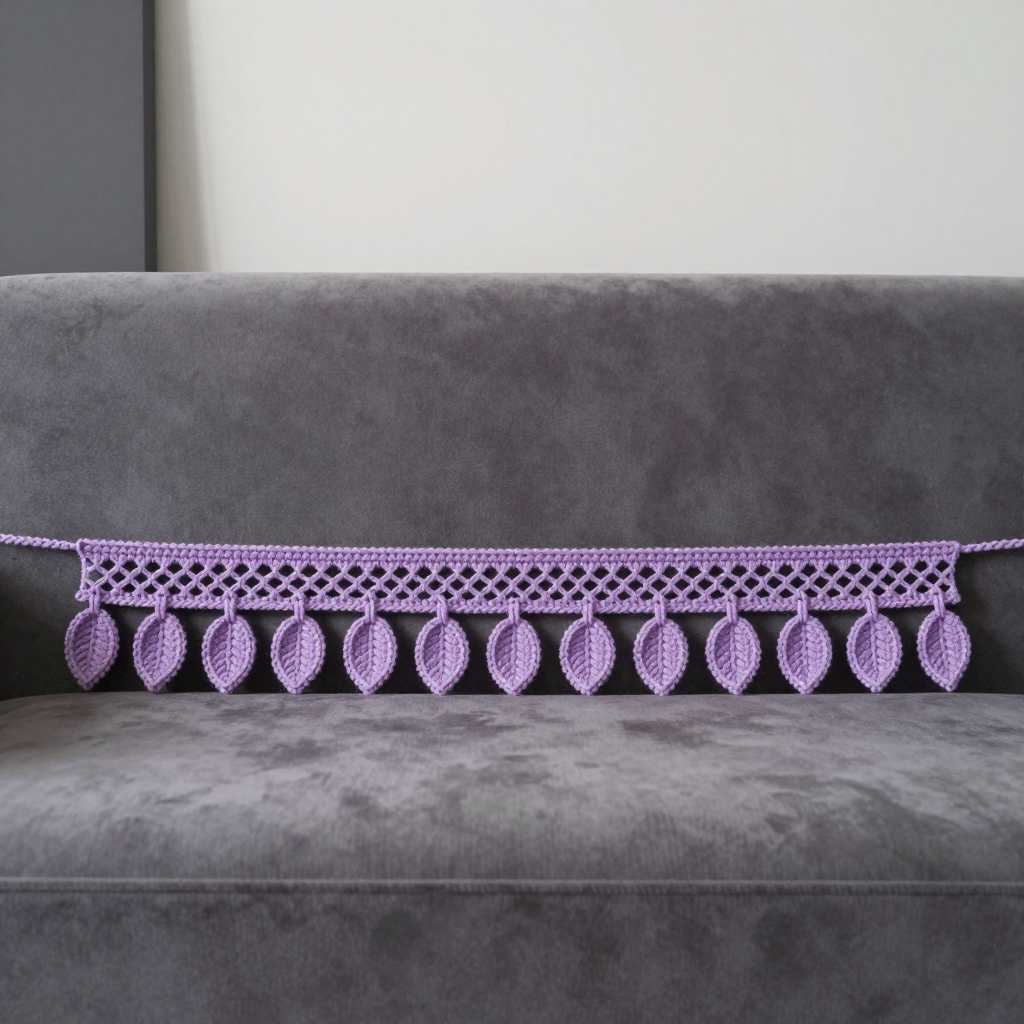
This Tropical Leaf Crochet Edging is a lovely little project for anyone who wants to add a handmade touch to a blanket, garment, or home decor piece. It is designed for advanced beginners who are comfortable with single crochet and chains, and it works up quickly in a single skein of lilac sport-weight cotton. The edging looks like a narrow open mesh band with small pointed leaves growing from one side, giving a soft tropical feel without any fussy color changes. It feels light and airy in the hand, and once blocked the leaves open up beautifully along the edge.
Materials Needed
- Yarn: Sport weight (CYC 2) cotton yarn, approx. 50 yds (46 m) in lilac. One small skein is plenty for a standard blanket edge.
- Hook: 3.5 mm (E/4) crochet hook.
- Notions: Tapestry needle for weaving in ends, scissors, and blocking pins or mats.
- Finished size: Edging width approx. 1.5 inches (3.8 cm); length is customizable and worked over a multiple of 6 sts + 3.
Abbreviations
- ch — chain: yarn over and pull through the loop on your hook.
- sc — single crochet: insert hook, yarn over, pull up a loop, yarn over, pull through both loops.
- sp — space: the gap formed by a chain (for example, a ch-3 sp).
- RS — right side: the front, public face of your work.
- rep — repeat: work the instructions between the asterisks again.
- sts — stitches.
Gauge
Gauge is 4 sc = 1 inch (2.5 cm) and 4 rows = 1 inch (2.5 cm) in single crochet. To check it, work a small swatch in sc and measure a 1-inch section; adjust your hook size if needed so the leaves sit evenly along your edge.
Tips Before You Start
- Count your set-up row carefully so the stitch count is a multiple of 6 plus 3; every leaf repeat depends on this.
- Keep your chain-3 loops loose and even so the leaves open up nicely after blocking.
- Work the set-up row evenly along your edge, spacing stitches so the band lies flat without rippling.
- Use a stitch marker at the start of each row to keep your place in the repeat.
Step-by-Step Instructions
The pattern is worked over a multiple of 6 sts + 3. Each row below is written once; repeat the bracketed section across to the last stitch of the row.
Set-Up Row
Set-up row: With RS facing, join lilac yarn to corner or edge. Ch 1, sc evenly along edge, ensuring stitch count is a multiple of 6 + 3. Turn.
Mesh Band
Row 1: Ch 1, sc in first sc, *ch 3, skip 2 sc, sc in next sc; rep from * across, ending with sc in last sc. Turn.
Row 2: Ch 1, sc in first sc, *ch 3, sc in next ch-3 sp; rep from * across, ending with sc in last sc. Turn.
Leaf Motifs
Row 3 (leaf round): Ch 1, sc in first sc, *ch 3, sc in next ch-3 sp, ch 3, sc in same ch-3 sp (leaf base made); rep from * across, ending with sc in last sc. Turn.
Row 4 (leaf tips): Ch 1, sc in first sc, *[ch 3, sc in next ch-3 sp] twice, ch 3, sc in same ch-3 sp (leaf tip); rep from * across, ending with sc in last sc. Turn.
Row 5 (leaf completion): Ch 1, sc in first sc, *[ch 3, sc in next ch-3 sp] three times, ch 3, sc in same ch-3 sp (leaf point); rep from * across, ending with sc in last sc. Turn.
Outer Edging
Row 6 (edging): Ch 1, sc in first sc, *ch 2, sc in next ch-3 sp; rep from * across, ending with sc in last sc. Fasten off.
Assembly and Finishing
Weave in all ends with your tapestry needle, working them into the mesh band so they disappear. Block lightly by misting the edging and pinning the leaves open to shape; let it dry completely. If you are attaching the edging to a blanket or garment, the set-up row is worked directly along that edge, so no seaming is needed beyond joining the yarn.
Pro Tips and Variations
- Try a contrasting color for the final edging row to make the leaf points pop.
- Work the repeat in a lighter cotton for summer projects, or a mercerized cotton for a subtle sheen.
- Use the same repeat along a sleeve cuff or pillow edge for a coordinated set.